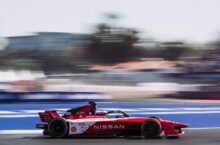
Shell’s partnership with the Nissan team in the all-electric Formula E racing series allows both companies to develop technologies to further develop projects for electric vehicle customers around the world. This is an important collaboration between two leaders who are helping to make electric vehicles more attractive to drivers.
As one of the world’s largest energy suppliers, Shell is uniquely positioned to leverage its technology and expertise to develop cleaner mobile solutions that will serve the growing number of EV customers. The Nissan Formula E team has successfully tested Shell e-Transmission Fluid, a specialty transmission fluid for electronic transmissions. It creates less friction and has anti-corrosion properties, increasing durability and reliability. The fluid allows the system to deliver more power while consuming less energy, giving the Nissan Formula E team a competitive advantage.
Effective temperature management is key to protecting sensitive electrical parts from overheating and ensuring their safe operation. Shell thermal fluids provide optimum insulation to maximize the performance of electrical equipment and prevent any damage caused by short circuits or leakage current. Thanks to their dielectric properties, thermal fluids provide direct cooling of the electric motor and inverter in the car, resulting in better heat transfer between the heat source and the coolant.
On the track, this partnership will allow the Nissan team to improve efficiency and bring it closer to the first position on the track. And Shell will develop and optimize innovative products and services: from faster and more efficient charging of electric vehicles to the development of Shell E Fluids and Shell E-Greases, a range of products designed to meet a wide range of performance requirements. By using Formula E as a test bed, the company is able to demonstrate the benefits of a specially formulated transmission fluid for electric vehicles that can withstand the extreme conditions of competition. And further transfer joint innovations from the track to the road as a critical step in global decarbonization.
Etiam magna arcu, ullamcorper ut pulvinar et, ornare sit amet ligula. Aliquam vitae bibendum lorem. Cras id dui lectus. Pellentesque nec felis tristique urna lacinia sollicitudin ac ac ex. Maecenas mattis faucibus condimentum. Curabitur imperdiet felis at est posuere bibendum. Sed quis nulla tellus.